
Forgetting the First
We discuss oblivion.

Forgetting the First
Because we learn so much without the ability to remember anything, some say that it is our first ability to demonstrate remembrance that defines the limit of consciousness. Once a child is remembering things, like its own name, it is ready to speak for itself (literally). Then too, the forgetfulness of losing oneself in the responsibility of duty or the Anacreontic ellipsis of pleasure in some Bacchic revolution comprises the Homeric artist’s necessary return to darkness after experiencing that most craved oblivion which it seems destiny originates.
We do not often think of people as having changed the world before they are born, but we sometimes (narcissistically) reflect that it is likely that two people should have a child that can change the world; or more optimistically, that two people having a child are always doing something to change the world and further the alliance of memory with reality in the pursuit of marriage between the order of the mind and the abstraction of the felt, sensed world which defies it. This essay discusses this miracle of interpolation
Interpolation is not to be used simply as a matter of discourse among scholars of the classics who look for ways in which new words have come to supplement, emend, or criticize the ur-product of the artist in antiquity, but rather as a disjunction of the sort that makes altercation possible, and through this deviation, the synthesis that is necessary for proving to ourselves that we are not just capable of memory, or capable of relinquishing memory, but are alive at all.
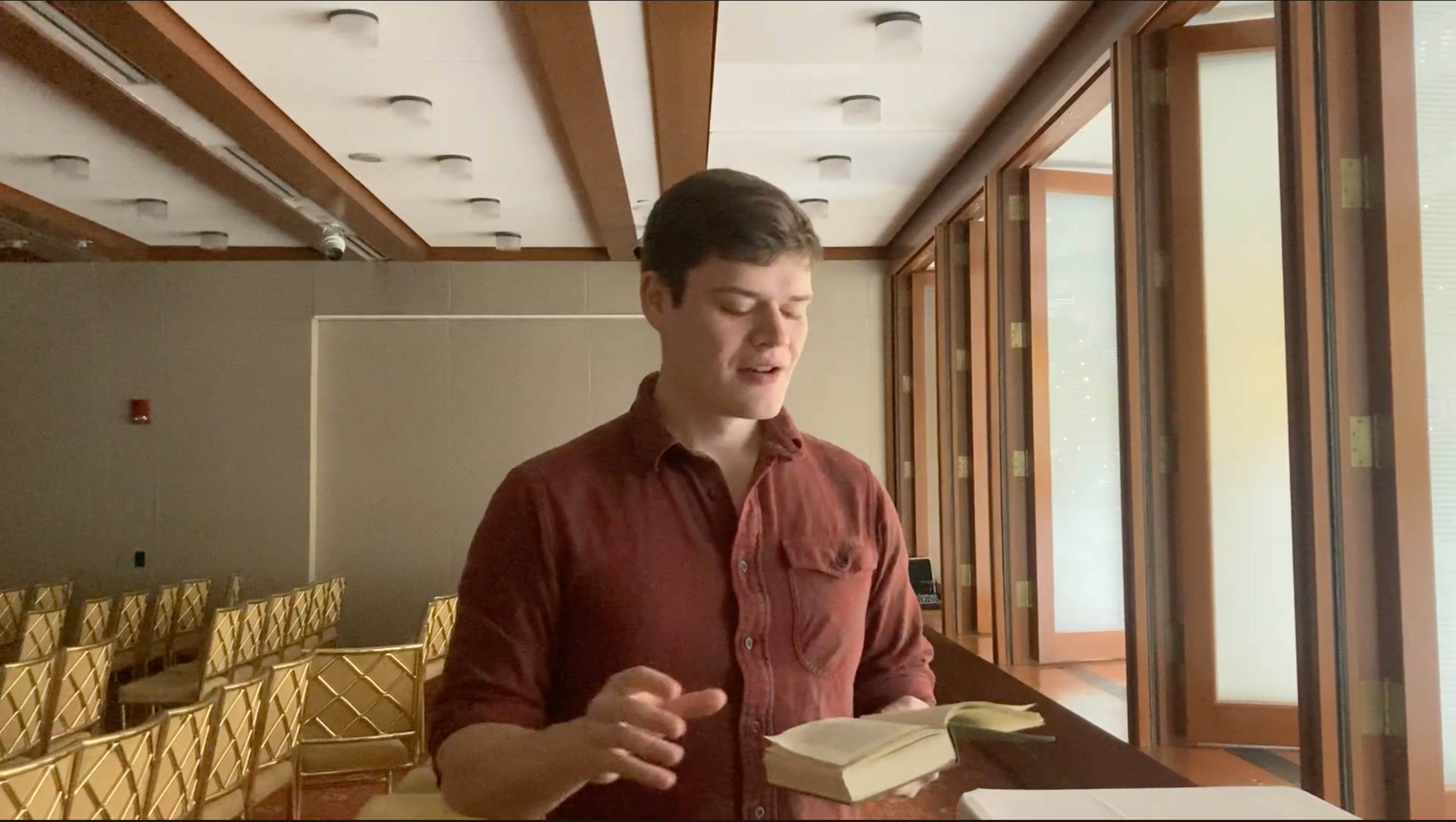
I offer the challenge to my fellow Homeric singers to try to memorize lines of hexameter. When I was in undergrad, I would frequently see my friends walking around Cambridge muttering poetry: I could see one of the memorizing Homer in particular, likely as a fruit of the spoken Ancient Greek course we had built for ourselves. I likened the glasses of the other like the dim high greys that come over the winter yews of mid-February frustration as little opuscules of what I now find I crave most of all, which is the error and omission of the instantiation of our success at the time, these difficulties; made as if the black box of creativity we had in our mimesis was more machine than we realized, in that its overarching logic was primary in its wonderful deliverance from the living, and that escape far more readily than the secondary, qualitative result allowed us to feel better about our studies and what clubs we were in, or who we liked.
That is, the primary challenge of enchanting memory seems to be the act of attempt and failure rather than the positing of any great solution for the world around us. By working with the largest story possible in the most information dense medium we can, which I argue is the art of Epic poetry, and formally Epic poetry in Ancient Greek as both a qualitative and a quantitative language, we undertake a task of remembrance and simulation that hones the appetite not for distinctly better abstraction, but the mere ability to recall, and enjoy the process of recollection at all. When we do so we come closer to the instinct that makes us all who we are, which is the desire to give this to others. The utility of the individual is only in its estimation from others, which gives us better insight into why the Homeric bard had to be blind.
The blind singer forgets the first aspect that is remembered when we come back from the art of recitation in that wonderful sympotic sense of joy in exulting among the treasures of sensation, or in the stern and rigorous sense of devotion that consumes lives for much longer and perhaps forever, the work and claims of a career or the necessity of action in a moment, relieved by violent victory or the deprivation of those career abilities. The singer made infantile through blindness is immobilized and allowed to convey these truths precisely because their aspect chasing abstraction is so powerful that, if not given this blindness through exception, no one would ever reach the amount of input of Epic grammar necessary for coming up with the high goal and achievement of the singer, which is the poetry itself. Otherwise, their powers would defeat their pursuit (for all but the manic), since they would get what they want through this skill.
The constructors of the greatest and most powerful edifices are contained in this forgotten individual, marked not just for their ability to refine verse into something that is powerful for the secondary, qualitative performance of a warrior, society, or work of art, but for their ability to easily traverse the boundary between poet-qua-divinity and human. So the ships are built using the words of the poet, and the ships are captained by the captains instructed by the poet, and the words of the poet himself are the full span of perfect prescription allowed by Homer; the Oak, the Ash, and the Tall Pine:
ἤριπε δ᾽ ὡς ὅτε τις δρῦς ἤριπεν ἢ ἀχερωῒς
ἠὲ πίτυς βλωθρή, τήν τ᾽ οὔρεσι τέκτονες ἄνδρες
ἐξέταμον πελέκεσσι νεήκεσι νήϊον εἶναι:
Iliad, 16.482-4
He fell like some Oak would fall, or an Ash
Or a Tall Pine: which men in the mountains, carpenters
Cut down for the making of mariners’ wood for ships, with their perseverance.
I find significance in all three of these types of trees in particular. The Oak is noteworthy for its evolution from the Rock, as we have discussed in these essays before. The Ash, ἀχερωῒς, is sometimes figured to be pre-Greek, or mythologically, a tree from the banks of Acheron; but in any case, it sounds to the Epic ear as ‘the painful Hero,’ or the ‘the despairing space.’ Then there is the πίτυς βλωθρή, the tall pine, the first of which is also impossible to etymologize, and the second of which is also likely pre-Greek and nebulous.
Finally, we have the notion of the carpenters, the comparison and rich similarity of our poet to which can include other builders (whether Jesus or the Masons, etc.), and most notably too, the idea that they are taking them down to make the reduplicated νεήκεσι νήϊον, the ‘wood made for ships, for ships,’ by use of axes, which I translate above as ‘perseverance,’ since that is what makes an axe different from a sword. It can’t be used as a sword in battle, but it can be applied to a moment in time that needs perseverance, like cutting down a tree, which the blunted, hurt individual like the blinded singer must use in order to hew away at the old myth for new myth, as the Tree did the Rock, in order to get at something more Tectonic and better, that emanation and conception of a future.
When we go back and forth between memory and passion, remembrance and forgetfulness of the first, we celebrate the world we live in best by doing so with the greatest love possible, which is in commitment to Epic composition, both for our own sakes and for the humility of realizing that those who can, or must, make such a sacrifice will eventually be emissaries for the divine.
"Interpolation is not to be used simply as a matter of discourse among scholars of the classics who look for ways in which new words have come to supplement, emend, or criticize the ur-product of the artist in antiquity, but rather as a disjunction of the sort that makes altercation [sic] possible, and through this deviation, the synthesis that is necessary for proving to ourselves that we are not just capable of memory, or capable of relinquishing memory, but are alive at all."
Interpolation is necessary for proving to ourselves that we are alive? I'm not sure I understand.
Is "altercation" a typo?