
The Homeric Hypertext
Week 13 of My Essays on Homer Performance.

The Homeric Hypertext
Most of us have woken up from a dream at one point. Recognizing the last firmament of poetry happens when our great lacerations of wit and discretion fail, and sleep’s mission itself must be made fruitful: this creative aspect, the call and gesture for something whole and belonging, the germination and then termination and subsequent labor of the artist, all come together in the cause for performance. They are interwoven, fully visible, and yet shrouded in a mystery that few are able to access; these, the only ones willful enough in trying not to let themselves be reconceived within the paradigm they must give everything for.
Dodging immolation in the presence of Homer’s dream gives me pause because I believe so much in aesthetics and arrived at a study of Greek music through their heroic notion. We sometimes think a telos of a classical musical education can be an excellence that repudiates the quotidian failure of circumstance and allows for transcendence. But the Self-Reliance needed there actually defies the standard we must learn from, and we fare better within a forgotten destination that we ourselves remember as significant only after we give our time, our life, and our purpose to the act of genuine love of poetry. The process necessary for this undertaking, and the hypertextual structure inherent in attempting to do so, are discussed in this essay.
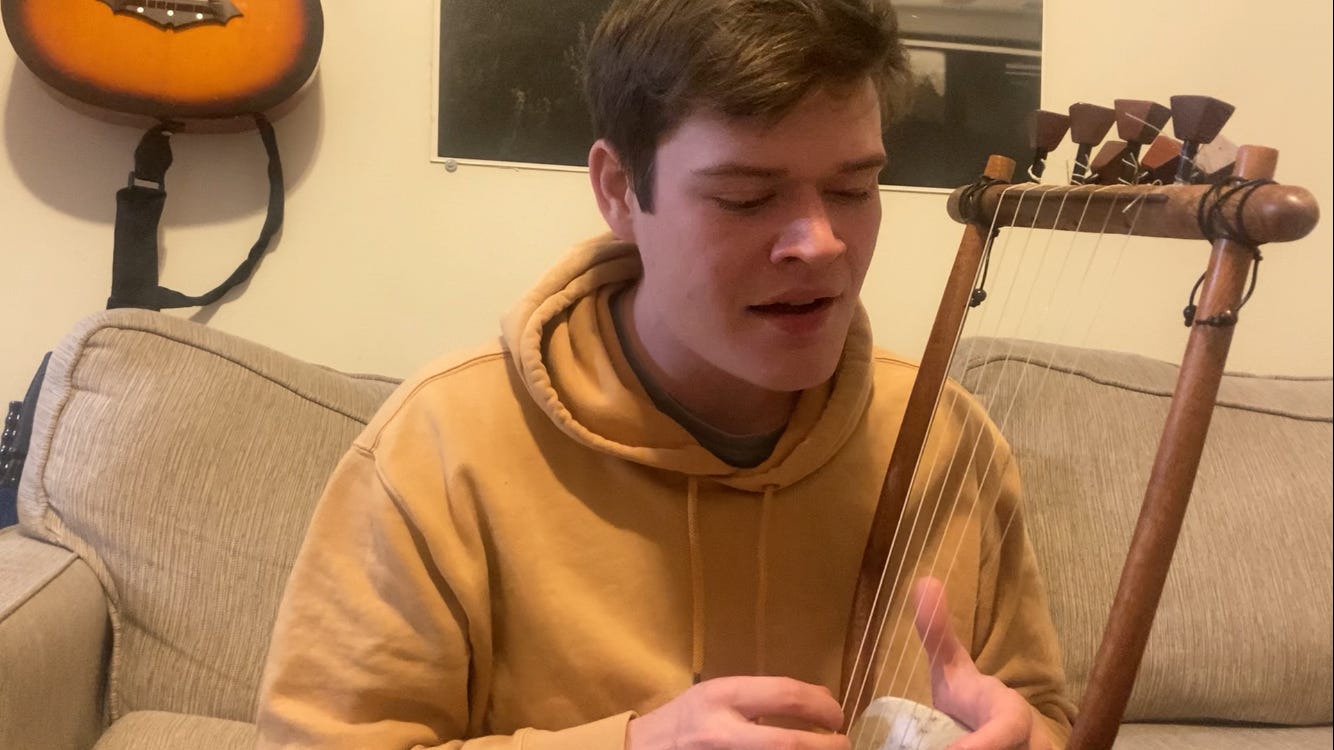
We must feel the tragedy of Agamemnon’s stuttering in the first book of the Iliad when he castigates Achilles’ attempt to rise above others:
τὸν δ᾽ ἀπαμειβόμενος προσέφη κρείων Ἀγαμέμνων:
‘ναὶ δὴ ταῦτά γε πάντα γέρον κατὰ μοῖραν ἔειπες:
ἀλλ᾽ ὅδ᾽ ἀνὴρ ἐθέλει περὶ πάντων ἔμμεναι ἄλλων,
πάντων μὲν κρατέειν ἐθέλει, πάντεσσι δ᾽ ἀνάσσειν,
πᾶσι δὲ σημαίνειν, ἅ τιν᾽ οὐ πείσεσθαι ὀΐω:
290 εἰ δέ μιν αἰχμητὴν ἔθεσαν θεοὶ αἰὲν ἐόντες
τοὔνεκά οἱ προθέουσιν ὀνείδεα μυθήσασθαι;
Il. 1.286-291
And answering him, wide-ruling Agamemnon spoke:
“You speak all these things as is fated, Old Man,
But this man, here, wants to be beyond all others
And wants to be stronger than them, to rule over them all,
And to show them all things: I believe there is one who will not be convinced of the
290 Indeed, if the Gods made him a spearman
Then on account of what did they give him such harsh things to speak of?”
There are four things which Achilles is erring by offering to do. He is erring by claiming to be the best of them (ἔμμεναι), he is erring by trying to be the strongest (κρατέειν), to take this supremacy and turn it to leadership (ἀνάσσειν), and finally, to show it and signal it (σημαίνειν). All of these are refuted by Agamemnon; in all this insistence he declares the impossibility that Achilles should overcome himself. He declares this on account of Achilles’ poetic aspect being improper for the occasion. He cannot see divine allocation to his enemy to pronounce, to mythologize, to convey these painful things (μυθήσασθαι), as Achilles is just a spearman. The gesture here is acute, and it ends the conversation for Agamemnon. Achilles responds, but after this, they do not speak for quite some time. These four verbs, and their turn to questioned authority for their acquisition and use, are the subject of every dreamer’s journey.
The dream (ὄναρ) becomes painful (ὄνειδος) when it is seen (εἶδος). I offer no concrete philological connection here, but the needs of the poet and the composite of the text require that we explore the dual world of hypnosis made possible through perfect refraction of an idea, a person’s entire essence and the transcendence of that into the art their life creates, and something that is beyond the dim amalgamation of the contemporary into a pastiche that fails to access authority through the most powerful anchor it can have, which is divinity alone: we know that Agamemnon is right, we know that Homer is right, because the medium by which Achilles’ life is conveyed is mustered against a force that it cannot stand up against in definition, and the whole inception of this tragedy of bloody riposte which Achilles offers is sentenced and passed on to us in the over and over again repetition of the story and lesson of the text in its whole demonstration, the ocean and the trip of the heralds directly following as submersion into the dreamlike state of disbelief and awe when we witness a soul’s attempt at mastering something else, and when they fail, the distinct feeling of death and waking up, a cessation from the constant chase (elsewhere discussed in Homer).
Hypertextuality proves these points. The text of the poem must be a complete and vivid dream. It must exist (ἔμμεναι), be robust (κρατέειν), rule over others (ἀνάσσειν), and of course, say something (σημαίνειν).
How are we to do this, if we are still in the Homeric dream? The only answer is to complete the trip into the “Homeric Underworld” of our cultural physics and listen to the way we respond when we become Homer again and attempt to access the same ladder to estimation that earlier poets were able to in the collection of the text; and when we do so, we realize that everything is complete with the high, genuine and lucid completion of the text like nowhere else. It is this completion that one feels when one accomplishes the hexameter in practice, and which the Homeric singer must take under their wing as the lift needed to access God if they wish to create something worthy of the infinite.